Tiny kitchens and chickpeas
On gentle writing about everyday cooking, being a dickhead at twenty, and cooking by trial and error

It took a mere two months to break my New Year’s resolution to keep this newsletter up. Laziness and writer’s block have wormed their way into my brain, and my attempt to chip away at these beasts has been to read more of what I love - gentle writing about everyday cooking. Alicia Kennedy’s excellent newsletter on domesticity prompted me to buy a copy of Laurie Colwin’s Home Cooking, a collection of recipes and essays on food. Colwin’s writing on cooking in her tiny New York City apartment struck a chord with me. Over the past few months, various social media algorithms have bombarded me with videos of rich women in their huge, perfect kitchens, serenely chopping vegetables on pristine marble worktops and making soups in £400 cast iron pots. It was aspirational content, addictive and calming and aggravating, all at the same time.
Having lived in London for almost a decade, I have had my share of tiny kitchens, the smallest of which was too bleak to even bear recollecting. Instead, let us venture to the kitchen I shared with Zuzka as students, in our apartment just off Madrid’s Puerta del Sol. The room was narrow and thin, with our counter space, hob, and fridge-freezer squeezed along the right side. The wall to the left was painted a cool yellow, and the floor tiles were terracotta with white grout. When we first moved from London, we thought the flat was the height of luxury: ensuite bathrooms! A living room! French windows in every room! And luxury it was - where in London could we live so centrally, in a building with heavy wooden doors, wrought iron staircases, and cool stone flooring in the hallway? Where in London could we even afford a living room?
Little by little, the flat unveiled small quirks that would affect our lives to varying degrees. We discovered that noise travelled through every wall in the house - we heard upstairs’ conversations through our kitchen exhaust, and when we heard the ping of our neighbour’s WhatsApp notifications, we could have sworn it was our phones. There were no local recycling bins or collections, so pizza boxes built up on our tiny balcony. Nonetheless, our irritation calmed, we learned to ignore the looming shadow of the pizza box tower, and I began to quite like listening in to the muffled arguments from upstairs while making dinner.
We were coming to Madrid as fleeting visitors, for ten short months, and equipped our kitchen accordingly - four flat white bowls from Ikea, one frying pan, and one large saucepan. The saucepan would be used and washed around four times a day, to poach eggs, then boil lunchtime pasta, and brewing cups of tea. Our student loans were paid in sterling, and we were enjoying the last year of the pound remaining strong, and ate out for at least one meal every day. A typical week would see us venturing out for tacos, Neapolitan-style pizza, baguettes filled with deep fried squid or thin slices of serrano ham, dulce de leche ice cream flecked with crumbled nuts, dumplings from a tiny restaurant in a car park under Plaza de España, little bowls of arroz negro from the Mercado de San Miguel that tasted of the faraway sea. Occasionally though, one of us would be crippled by a hangover (me), or struck with a longing for domesticity (Zuzka), and we would return to cooking at home. The homecooked meals I executed were on a narrow rotation: spaghetti carbonara, penne with chorizo and goat’s cheese, pesto chicken salad, and - when I felt particularly homesick - chana masala.
Chana masala was the first Indian meal I made in Spain. I walked to Lavapiés, where I knew I could find South Asian grocers, and asked a shopkeeper whether he stocked chana masala powder. After what seemed like an age in the back room, he emerged with a box of Laziza chana masala mix, covered in a fine film of dust. I went home and FaceTimed my parents, who told in no uncertain terms that I should never use than more than half the recommended amount of masala. Like most twenty-year-olds, I ignored this parental advice, and followed my instinct. I figured that the masala would be a little stale, and used twice the recommended amount. The resulting dish razed my entire digestive tract. Despite my failure, I powered through, ladling yoghurt onto my helping of chickpeas and rice, and wiping away the beads of sweat on my face. Twenty is a truly dickhead age, and I often left a trail of destruction in that tiny kitchen, leaving an exasperated Zuzka to scrub turmeric stains on the counter and sweep grains of rice off the hob. Perhaps my abdominal pain was a form of retributive justice.
In any case, it took me ages to get chana masala right, and I still ruin it regularly. Over seven years have passed since I moved home from Madrid, and I have made countless mistakes in that time, mainly fuelled by laziness or fear: not cooking the onions long enough, not adding enough masala, under-salting, over-salting, too many tomatoes. Last year, I burned a batch so badly that I had to soak the pan for two days. But I’m getting there: my most recent batch required neither antacids, nor an obscene amount of yoghurt, to make it edible. It’s a dish I love enough to keep on trying.
The below is how I make my chana masala. This isn’t necessarily the OG chana masala (or chole, as it’s also known). Iterations exist across South Asia, and it’s a staple in Northern Indian and Pakistani diets, but this is how my family like it. Chana masala can take hours, or it can take minutes - my family and I take the speedier route, and I don’t think our dish is worse for it. If you want to cook chickpeas from dried and make your own masala mix from scratch, Cook with Manali and Swasthi’s Recipes are two of my favourite resources for Indian vegetarian cooking.
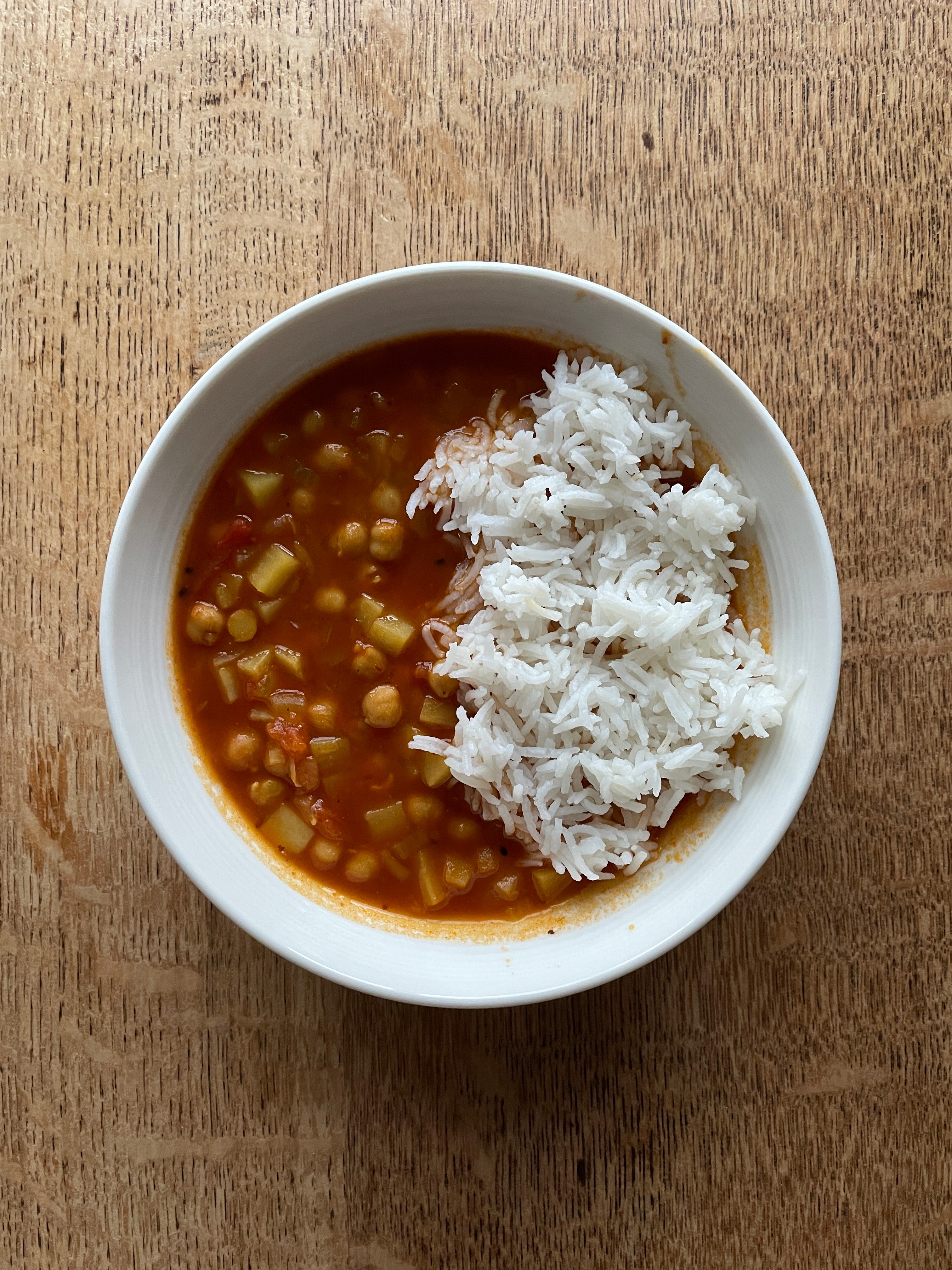
Speedy chana
Serves 3 to 4, but it’s worth doubling up to batch cook and freeze
Ingredients
Vegetable oil or ghee
2 tins or 1 large jar of chickpeas (I prefer the latter, as the chickpeas tend to be softer, but the former is less expensive and still great)
2 fresh tomatoes (if in season), chopped, or a tin of plum tomatoes
2 large-ish potatoes, skin-on, cut into 1cm cubes
2 onions, finely chopped
A couple of cloves of garlic, sliced (optional)
2 tablespoons of good quality chana masala powder (I like Laziza or Shan)
Lemon juice (optional)
Coriander (optional)
Chaat masala (optional)
Method
Add the oil to a large pan and turn on the heat. Once it’s hot, add the onions, stir, and add a pinch of salt.
Cook the onions until soft and golden.
Add the garlic, and fry for another four to five minutes. If the onions catch at the bottom of the pan, add a little splash of water to loosen them up.
Add the tomatoes to the pan with the masala powder. If using tinned plum tomatoes, break them up with the back of your spoon.
Fry this mixture for at least ten minutes on a medium heat, until you can start to see the oil separating. Try a bit of the mix at this point - could it do with more masala? More salt? Have the spices cooked enough, or do they taste raw? Adjust according to your preferences.
Add the chickpeas (I tend not to drain them, but this is a personal choice) and the potato, and stir until everything is well coated.
Add enough boiling water to cover the chickpeas and potatoes, and leave on a low heat with a lid on. Boil until the potatoes have cooked through.
If you want a thicker texture, you can leave the lid ajar so that the sauce cooks down a little more.
Before serving, add a squeeze of lemon juice, a sprinkling of chaat masala, and some chopped coriander. This is all optional, but I find it lifts the dish.
Enjoy with rice, naan, roti, toast, or with a fried egg on top.